The Sequel to OBX, and How to Change the Ending
The IFPA has banned a trans woman from the women's tournament at the IFPA's PAPA23 Pinball World Championship. Here is her firsthand account.
This happened as a followup to OBX Fall Flippers, the event that was a pinball tournament for cis people and a hate crime for trans people. The woman that the IFPA just banned is one who protested the IFPA over this, five months ago.
My previous posts on the topic:
- Trans Exclusion at OBX (my original account of the debacle)
- Six Months After OBX (about the IFPA's terrible followup)
- Unfortunately Frequently Asked Questions about Transphobic Pinball Events
You can also read the NBC News article by Jo Yurcaba that resulted from these events.
I'm calling this "the sequel to OBX" not because the same thing is happening - there hasn't been any hint of bathroom exclusion or the cops being invoked - but because it follows on from the events of OBX, it's bringing up similar themes, and some of the same characters are involved. Like a sequel.
We need to talk about it. We need to change the ending.
What happened?
In November 2025, in Grandy, NC, the transphobic debacle at OBX happened. The IFPA failed to follow their own rules on inclusion, and failed to protect trans people. This is on the record in an official IFPA statement.
In March 2026, a Chicago-area pinball player, Kayla Bivens, sent a letter of protest to IFPA staff members including Andy Bagwell, who is a TD for some Chicago tournaments. Andy had been highly involved in the terrible response to OBX -- in the immediate aftermath in November, he and Josh Sharpe decided to publish all the internal chats leading to the decision in a blog called The Kineticist. The chats contained unredacted personal information of the victims, at a time when the local players in Grandy were threatening to shoot us. You're really hoping that I'm exaggerating. I wish I were exaggerating.
Andy also added a personal statement claiming that "the trans community" (as if it were a singular thing!) was on his side, and deflecting blame for the decision to the IFPA women, who had all already resigned in protest. The author of The Kineticist, Colin Alsheimer, added his own man-positive spin on the article that accepted Andy and Josh's framing, despite the very different situation that anyone who sees women as equal human beings would be able to see when reading the chat logs below.
I need to extend the assumption that Andy's actions, up to this point, were not taken out of malice. He was reacting to a developing situation. He was reacting emotionally, not thinking or doing PR, and he made some impulsive decisions and worded things poorly. He doesn't know what it is like to be trans, so he doesn't understand that there are many trans communities, and he doesn't know the threats we face.
Many have asked us what we are asking for after OBX. Kayla's protest letter explains our concerns and demands clearly, point by point. If anyone has told you it's some kind of inappropriate, unhinged manifesto, maybe try reading it. One of the demands was "talk to the women that were harmed". Another was "give us back our option to opt out of the IFPA".
A protest has to be backed by action. Because Andy categorically refused to engage with the letter, the plan was that Kayla and supporters would hold a play-in protest at Andy's next tournament and distribute copies of the letter to attendees.
The venue heard of the conflict and cancelled all their tournaments, and Andy escalated the rhetoric on Facebook. He wrote a post targeting Kayla, deleted all replies that disagreed with him, and blocked even people who politely replied that he shouldn't do this. The long comment thread filled up only with people supporting Andy, and lots of prominent people in pinball saw only Andy's side of the story, turning them against our community.
This is the point where Andy owes us accountability, because this was harassment, people told him he was doing harassment, and he chose to block those people.
The protest never happened. Kayla avoided Andy and his tournaments from then on. Several months went by.
Now, Kayla is banned from the upcoming women's tournament at PAPA23, and the reason is that those running the tournament (including Andy) are retaliating against Kayla's protest. They have justified themselves with a narrative painting Kayla as a dangerous person, which is ridiculous if you've met her, but it's a narrative that cis people often weaponize against trans people.
(I want to be careful with the name of the tournament that excluded Kayla. The tournament is called "PAPA" by many pinball players, but people involved with the actual Professional and Amateur Pinball Association have clarified that they did not do this and are not running this tournament. The IFPA licensed the PAPA name for this tournament weekend.)
Kayla's protest plan was peaceful, endorsed by the OBX victims, and justified by the IFPA's suppression of trans advocacy. Now, she's being singled out and punished. She's being held responsible for everything the IFPA is frustrated with about the trans players who hold them accountable for OBX.
It is a fact of IFPA pinball that TDs can ban anyone, and that's meant to protect the community, when the TD is acting in good faith.
But this action doesn't look like good faith, given the history of the situation. It's the opposite of what the IFPA needed to do, and things are a lot worse now that they have done it. They've made the task of reconciling with our community a lot harder. And I have to hope against hope they still do want to reconcile with our community, when they appear to want to destroy it instead.
But what if Kayla actually did something wrong?
Kayla has been an advocate for justice and equality, and those are not wrong. In the particular conflict that the IFPA is holding against her, the events involved were cancelled, and yet she's still blamed for things that didn't happen.
We can talk about what didn't happen. I find her plan for the protest she intended to lead to have been, maybe not perfect, but proportional to the situation. She had to bring up certain uncomfortable topics internally with the members of her protest, such as how to keep protestors safe if venue security got involved or if players started threatening the protestors. Uncomfortable discussions like that are important to consider in a protest. It appears that her protest plan was leaked to Andy by a betrayer, and it looks like those are some of the things that have been brought up to paint her as dangerous -- because she realistically considered the danger inherent in a protest.
Maybe you disagree, and you find something in her plan to be harmful. I want to show you a few panels from Dumbing of Age, by David Willis, a long-running comic that has touched on trans issues.
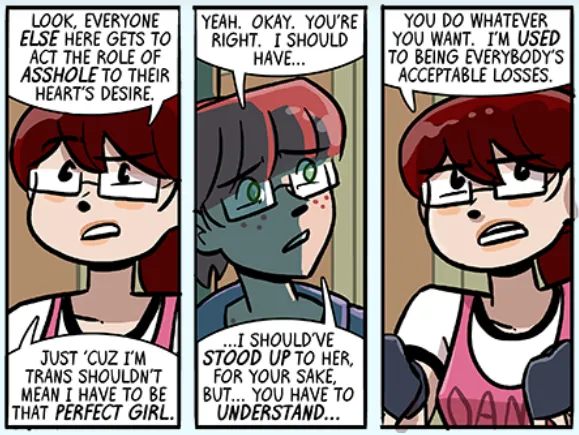
Carla (the trans character here) is far from perfect. But what Carla is saying is so extremely familiar to me. When the consequences of a transphobic situation fall on Carla alone, her dorm RA says what she should have done to make it right. But as with Josh Sharpe, it is not helpful to merely say what you should have done, if you aren't going to change anything to make it right.
Much of this feels like what happened at OBX, except we didn't get to have the narrative turning point, the part where the storyline wraps up cathartically and the characters get to go on to other tribulations. We're still in the same place. The pinball community has told us, over and over, that we are acceptable losses, and that's all they expect us to be, and they would rather defeat us entirely than examine themselves.
"Can't we all just play pinball?" they say, when "we all" no longer includes all of us.
How transphobia happens, and how to undo it
A point of conflict is that the actions of IFPA staff members have been called transphobic, and they're very upset about that. (Trans players are pretty upset about some things we've been called, as well.)
While we all have to deal with negative perceptions sometimes, there is a straightforward remedy to being called transphobic -- it's talking to the affected trans people and doing the work to improve the situation.
One of the problems we run into is: we try to call out the transphobia that people in power are implementing, something that is really definitely happening, and those we call out have a desperate, panicked reaction. They usually can't even handle acknowledging it. They feel the only way forward is to deny everything and cover up the situation.
Transphobia is a problem in our society. A huge one. Transphobia is not just about what one person does or says. Transphobia is about how in our society, trans people are feared, we are distrusted, we are seen as wrong and unreasonable, we are seen as acceptable losses and even acceptable targets of violence.
Men who would never consider threatening violence against a cis woman, for example, will threaten violence against trans women (and that happened at OBX, in the local players' group text). Moreover, when trans women are targeted, it is usually portrayed as being our fault.
Deep breath. It can be okay. If you have a bad interaction with a trans person once, you're not doomed to be a bad person who's going to gender hell forever. What's important is that you understand what happened, you own up to it, and work with trans people to address the societal problem that got you there.
The IFPA said they wanted to stand in solidarity with trans people. I'm going to bring up some situations where we've been affected by transphobia, and instead of doing anything like solidarity, the IFPA only served to tip the balance more against trans people. Imagine how these situations could have been different in a more equal world.
When the full story of OBX was coming out, a lot of people directed undue blame at Samantha Bacon (a trans woman who was IFPA staff at the time and present at the tournament) for communicating unclearly as the terrible situation developed. Imagine if people had scrutinized the actions of any of these people just as much: Kevin Stone, Josh Sharpe, and Adam Becker. Samantha took a fall, and none of these others did. Kevin Stone was the TD and he knew it was happening. If you're not holding him responsible for what happened on his watch, what are you even doing?
After OBX, there were people taking our side and saying mean things about Sharpe, Becker, and Bagwell. Trans players, especially the OBX victims, have been held responsible for the things people said. But imagine if, likewise, cis people in power were held responsible for the extremely harmful things that some pinball players say about trans players, frequently. Not only in the dregs of Facebook comments -- there is a major TD who compares trans women to rapists and backs up his opinion with articles from anti-trans hate groups.
- You might just now be having a panicked reaction like "oh my god the transes are coming to cancel me for what someone else said, it's not even my fault", and in that case I want you to start reading this section over.
In the months after OBX, the IFPA turned the narrative sharply against the OBX victims. Our many advocates were silenced anywhere that the IFPA holds influence. Every time we spoke up for ourselves, we were painted as cranks and rule-breakers. The men responsible got to tell their story, over and over, until it became seen as true. The other thousands of pinball players who just don't care that much about trans rights won the narrative. The general perception about the OBX victims now is we must have done something wrong. Imagine if we had gotten to keep telling our story instead.
I've asked you to imagine a more equal world than the one we live in. Think about what would happen in that world, and work toward it. Work with us to figure out how the situation got here, and work with us to change the situation to be more equal.
I know the IFPA may think they've done that with the policy clarification and asking TDs to check a box and stuff, and we've been saying that that hasn't been enough to fix anything. There still isn't a process for protecting trans people when things get bad. This Chicago incident is one of many indications that things have gotten worse for trans players, not better, since OBX. There has been another incident since, and I am waiting for the trans woman affected to decide whether and how she wants to come forward about it.
Believe what happened to us and how it affected us. Let us tell our side of the story without punishing us further, chiding us, blocking us, or banning us from more things. It might be painful for you, and as much as we don't want to cause more pain, there is pain here, and so far it lands overwhelmingly on us.
At the start of August, I was personally ready to accept playing in a flawed IFPA while also supporting alternatives, and then this happened. Reconciliation is going to be harder now than it would have been then. But what other choice is there?
What can I do?
The IFPA's PAPA23 decision has further harmed trans inclusion in pinball. Don't harass them, but don't be silent about it.
Focus on the IFPA. Don't let anyone else catch strays because of the name and licensing of the tournament. This is not about PAPA, the Replay Foundation, or the memory of Lyman Sheats. The IFPA, possibly even a small subset of it, made this decision, as part of their ongoing systemic failure on trans rights.
If you hear someone painting Kayla, the OBX victims, or trans players in general as unreasonable enemies of pinball, push back against that narrative. Our equality in pinball depends on it. We are looking for a solution, "pretend nothing happened" is not a solution, and we need those in power to be willing to meet us, not dehumanize and silence us.
On a local scale: Host and attend pinball tournaments that aren't affected by the IFPA. Help build something better. We don't want to segregate pinball, but we have to have viable alternatives, or else it will be impossible to ever hold the IFPA accountable for anything. For my part, I'm hosting Punk Rock Pinball tournaments in NC and the regional finals in February.
If you hold power in pinball: we've already been very clear about what you should do. Listen to us. We've been giving you recommendations about how to fix things. Kayla's letter was another example. We write these things for a reason. It's not that we hate you and we want you to suffer. It's that we want the situation to be better, and we are telling you how.
Respond to us as real people who matter. Stop making things worse by punishing us more for what happened to us. You promised us solidarity, and the next best time for you to start giving us that solidarity, to start working with us instead of against us, would be now.